Amazon Discloses $36.7 Million Stake in IonQ



Insider Brief
- Amazon disclosed a $36.7 million stake in quantum computing firm IonQ, prompting rising expectations of growing institutional interest in next-generation computing.
- The stake, revealed in a quarterly SEC filing, makes Amazon the largest publicly known tech company investor in a quantum hardware company and adds to its broader quantum strategy through AWS and Amazon Braket.
- Analysts view the move as a potential catalyst for increased investor confidence in IonQ and a signal that cloud providers may escalate competition in securing future quantum computing infrastructure.
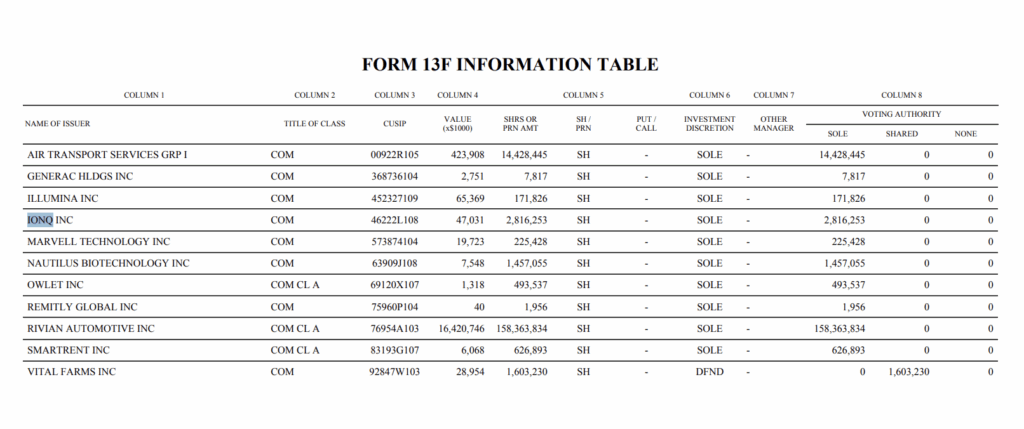
In a quarterly 13F filing with the U.S. Securities and Exchange Commission (SEC), Amazon disclosed ownership of 854,207 shares of IonQ (NYSE: IONQ), a position absent from its previous disclosure. The stake, valued at $36.7 million based on recent trading prices, marks what appears to be the largest publicly disclosed investment by a major technology company in a quantum hardware firm.
Though the filing listed the stake as new, earlier regulatory documents indicate Amazon has held positions in IonQ throughout parts of 2024. The latest disclosure may reflect a formal acknowledgment of earlier accumulation, or a shift in strategy toward greater visibility in the quantum space, analysts suggest.
Founded in 2015 as a spinout from the University of Maryland and Duke University, IonQ builds quantum computers using trapped ion technology. The approach relies on individual atoms held in electromagnetic fields to serve as qubits—units of quantum information, which proponents say offer better stability and connectivity than some competing architectures.

IonQ was the first pure-play quantum computing company to go public, debuting on the NYSE via a SPAC merger in 2021. Since then, it has pursued commercialization aggressively, including partnerships with Microsoft Azure, Google Cloud, and Amazon Web Services (AWS). IonQ’s systems are available through Amazon Braket, AWS’s quantum computing service.
How to Read The Investment
There are several ways analysts are looking at this investment in IonQ — and in the quantum technology industry in general. Amazon’s investment points toward the strategic importance of quantum infrastructure, particularly for cloud service providers seeking long-term technological advantages. AWS has been building out its quantum capabilities through Braket and its Center for Quantum Computing, operated in partnership with Caltech.
The movement may also reflect renewed optimism from investors, many of whom view the company as a frontrunner in the race to build practical quantum machines among the publicly available quantum stocks.
While the long-term potential of quantum computing remains a subject of debate, analysts say Amazon’s backing could improve investor sentiment and help IonQ weather near-term risks, including uncertain revenue timing and high capital costs that are typical of quantum and deep tech companies.
Looking further out on the investment trend landscape, news of Amazon’s move might place competitive pressure on other cloud providers to deepen their stakes in quantum startups or risk being left behind in what many see as a foundational shift in computing.

Keep track of everything going on in the Quantum Technology Market. In one place.

Matt Swayne
With a several-decades long background in journalism and communications, Matt Swayne has worked as a science communicator for an R1 university for more than 12 years, specializing in translating high tech and deep tech for the general audience. He has served as a writer, editor and analyst at The Quantum Insider since its inception. In addition to his service as a science communicator, Matt also develops courses to improve the media and communications skills of scientists and has taught courses.
[email protected]

Stay Ahead of Quantum
Get the latest research, company news, and market intelligence every week.
MENTIONED IN THE ARTICLE

Amazon
Amazon is a multinational technology company founded in 1994, headquartered in Seattle, Washington. The company focuses on e-commerce, cloud computing, digital streaming, and artificial intelligence. Through its Climate Pledge Fund, established in 2020 with an initial $2 billion investment, Amazon invests in companies developing sustainability-focused technologies and services to help achieve net-zero carbon emissions by 2040.
→

IonQ
IonQ is a developer in trapped ion quantum computing founded in 2015 that actively applies its technology to the aerospace and defense sectors. The company empowers satellite-based quantum networks and quantum enabled drones to improve positioning, navigation, and timing resilience in GPS denied environments, and collaborates with industry leaders like Airbus to optimize aircraft loading.
→

Amazon Web Services (AWS)
Amazon Braket – A fully managed service that allows scientists, researchers, and developers to begin experimenting with computers from multiple quantum hardware providers in a single place. Bra-ket notation is commonly used to denote quantum mechanical states, and inspired the name of the service.
→

University of Maryland
The University of Maryland, College Park, situated in Maryland, is a public research university. Established in 1856, it holds the position of being the main campus of the University System of Maryland. It also holds the distinction of being the biggest university in both the state and the Washington metropolitan area.
→

Duke University
Duke University, a privately funded research institution situated in Durham, North Carolina, USA, originated from Methodist and Quaker roots. Initially established in the current city of Trinity in 1838, the university relocated to Durham in 1892.
→
Microsoft
Microsoft engages in the creation and licensing of software for both consumer and enterprise use. The company is renowned for its development of Windows operating systems and the Office suite designed for productivity. Microsoft's structure encompasses three major segments of roughly equal size: productivity and business processes, which encompasses legacy Microsoft Office, cloud-based Office 365, Exchange, SharePoint, Skype, LinkedIn, and Dynamics; the intelligence cloud, which includes offerings like Azure, Windows Server OS, and SQL Server; and more personal computing, which covers Windows Client, Xbox, Bing search, display advertising, and a range of Surface laptops, tablets, and desktops.
→